
We’ve been asked to think this week about the importance of metadata in eLearning. In his introduction to the metadata study theme, Martin Weller focuses on its role in making learning resources transparent and findable:
It is [its] potential to make resources more accessible to effective searching and the subsequent promotion of content reuse that makes metadata significant for learning.
(H806-08/Connected learning in practice/Metadata)
Vital as this identifying and labeling role is, however, I think Martin’s formulation understates the significance of metadata for educators and learners.
Properly understood, the term metadata encompasses more than just the web-standard header tags (title, description, keywords, script, creation date) that virtually every web page carries, or even the more comprehensive or specialised metadata sets such as Dublin Core or the UK Learning Object Metadata set. Every hyperlink on the web is a statement of relationship between data at the anchor location and data at the target location. Every online database or directory which helps to organise and categorise the web depends upon a pre-defined taxonomy which, again, describes relationships between different bits of data. Every user-generated tag describes someone’s individual take on the significance of a particular set of data. And Google’s regularly-updated back-up of the entire world wide web, stored for indexing purposes on half-a-million servers at Mountain View, California, is arguably the mother of all metadata sets.
Metadata is woven in to the fabric of the web. If eLearning is learning that takes place online and interactively, then metadata is what makes it possible.
Metadata and learning meet in a theoretical convergence zone. The act of writing metadata is one of stepping back from the immediate experience, considering and interrogating it. It involves asking questions like:
- What sort of data is this?
- What are the key points, and how could it be summarised?
- What is its internal structure?
- What other data does it relate to, and how?
- What conceptual patterns, categories or hierarchies does it fit into?
The act of metadata-making, in other words, is an act of metacognition. It is an act of reflection, which is agreed by virtually all learning theorists – from Dewey and Habermas, through Kolb and Schon to Boud and Moon – to be central to all but the most surface kind of learning.
Metadata is not just about indexing and locating learning objects. It is at the heart of learning itself.

Diana Laurillard’s conversational framework feels like a very powerful model for understanding how formal learning works and how best to design effective learning objects. It is the best kind of theory: one that informs practice. It starts by identifying the main characteristics of a learning encounter, develops from these a typology of learning experiences, and finally maps this to a taxonomy of media forms appropriate to each type of experience.
Building on the Socratic tradition of dialectic, the social constructivist learning theories of Vygotsky and Piaget and the conversation theory of Pask, Laurillard maintains that all complex learning involves
a continuing iterative dialogue between teacher and student, which reveals the participants’ conceptions and the variations between them… There is no escape from the need for dialogue, no room for mere telling, nor for practice without description, nor for experimentation without reflection, nor for student action without feedback. (Laurillard, 2002)
She divides her learning conversation into four phases – “the basic characteristics of every learning encounter” – as follows:
- a discursive phase in which the teacher presents a new concept and learners enter into a dialogue with the teacher, trying out the idea and its corresponding language, questioning and clarifying.
- an interactive phase in which learners interact with teacher-constructed tasks, attempting to put the new concept into practice, and getting feedback on their performance
- an adaptive phase in which learners attempt to put their ideas into practice, modify their ideas and adapt their actions in the light of what they have learned, and make their own links between ideas and events; and
- a reflective phase in which learners consider their experience of 2) and 3), reflecting on their learning, relating the theory back to the practice, adjusting their thinking in the light of reflection and framing future actions to be more successful.
Next, she adduces from these characteristics a fourfold typology of learning experiences, like this:

Finally, Laurillard turns to the characteristics of the different teaching media – which she groups into narrative, interactive, adaptive, communicative and productive media – and maps these media forms to the types of learning they support, and the technologies needed to deliver them. The resulting taxonomy looks like this:
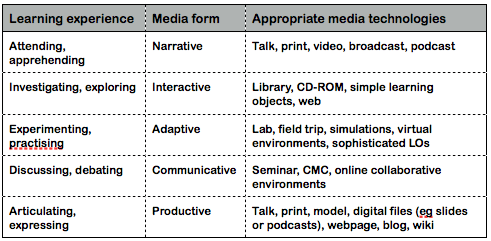
Laurillard’s framework is intended to define any formal learning encounter, and the appropriate media technologies she lists include traditional as well as digital ones. But for eLearning practitioners the framework poses the question – which online technologies are best suited to supporting the range of experiences needed for signficant online learning to take place?
Here’s my attempt at an answer..
Narrative media such as digital text, video or audio files are readily attended to and aid apprehension by providing structure and coherence to the learning content. However they are linear media. They can present only the teacher’s ideas, terminology or instruction – not the learner’s reaction or reformulation of them. They support only the first, non-dialogic, part of the discursive phase of learning.
Interactive media such as hypertext, simple learning objects and the world wide web itself are non-linear media and therefore support exploration and discovery. They allow students to make their own links and follow their own lines of enquiry. They also allow some limited intrinsic feedback (ie feedback that comes from the activity itself) and, when combined with narrative media setting goals and giving guidance, interactive media can support the discursive as well as the interactive phases of the learning encounter.
Adaptive media such as more elaborate learning objects, simulations and virtual environments give the learner significantly more control over their interaction with the learning experience. Learners can experiment with changing the parameters, can model systems or environments, and can see what happens when they try to put their new learning into practice. They can also get more detailed intrinsic feedback, and may be able to log the interactive process and thus begin to reflect upon it. Adaptive media therefore support both the interactive and adaptive phases of a learning encounter, and may also support the final reflective phase as well.
Communicative media such as CMC, chat and online social/collaborative environments obviously support the discursive dimension of learning. The discussion and debate that these media allow with both teachers and other learners support the second, dialogic, part of the discursive phase of learning; but they also provide an additional source of learning content in the form of information and ideas, and enable extrinsic feedback during the interactive and adaptive phases – thus supporting reflection during the final two stages. Communicative media (eg in the form of wikis and blogs) can even provide the output of productive learning. On their own however they cannot easily support the interactive and adaptive phases of the learning encounter.
Finally, productive media such as a webpage or blog post or digital object or model of some kind – these enable an output from the learning in which the learner articulates and shares what they have learned, considers the learning experience, adjusts their original conception in the light of the interaction, and reflects upon the significance of the experience. Productive media support the final, reflective phase of the learning encounter, and will often overlap with communicative media.
What emerges is that while each media form supports a different dimension or dimensions of the learning encounter, none of them can support every dimension. Narrative media support the apprehensive dimension and may be all you need for a purely instructional approach; interactive and adaptive media support immersive, exploratory learning and on their own result in a game-like experience; communicative media support the discursive and productive dimensions, and for pure peer-to-peer learning may be all you need. But to support the kind of deep or complex learning which engages all the phases of the learning encounter, you need a combination of media forms.
Reference:
Laurillard, D, 2002. Rethinking University Teaching: A Conversational Framework for the Effective Use of Learning Technologies, 2nd edition. London: RoutledgeFalmer

Two heads are obviously better than one – but how much better? Certainly a lot more than x2. All the evidence suggests that in general groups of people are much, much better at solving problems than individuals, and that really big, diverse groups are the best problem solvers of all. As James Surowiecki put it, “groups are often smarter than the smartest people in them.” (Surowiecki, 2004).
The problem of how to organise and classify all the world’s knowledge, for example, is one that many very clever individuals – from Liebnitz and Wilkins to Otlet and Bush – have tried and failed to solve. The problem is arguably in the process of being cracked today by a combination of Google plus the collaborative efforts of hundreds of thousands of ordinary web users and the user-generated taxonomy, or folksonomy, of social bookmarking.
Online bookmarking sites like Del.icio.us and Connotea are much more than just convenient places to store and organise every link you might need again – though they are that. Because they’re social, they help eLearners to be cleverer in three separate ways.
1. Plugging in to the global brain
You can use the clouds of tags created by other users to sample what thousands of people all over the world wide web are reading or saying about any topic that interests you. It’s like plugging into a vast collective intelligence and is a great way of running into things that you on your own would never have run into.
2. Harnessing the power of We Think
By thoughtfully applying tags of your own to your bookmarked items, you begin to share bookmarks with all the other users who’ve applied the same tags and are therefore thinking about similar stuff to you. This enables you to tap into a rich communal reservoir of knowledge and ideas, and harness what Charles Leadbeater calls We Think or “the power of shared intelligence to sort wheat from chaff”(Leadbeater, 2008 ).
3. Joining a community of practice
By hooking up with other learners who share your area of study to form a kind bookmarking circle (networks in Del.icio.us, groups in Connotea) you can enter into a highly efficient community of learning practitioners, reading what they’re reading, sharing comments as well as bookmarks, sparking ideas – and all simply as a by-product of saving and tagging your links.
Social bookmarking is such a great eLearning tool, because eLearning is a social practice.
For the record, my H806 bookmarks – shared with my fellow students via the H806 tag – are at http://delicious.com/johnmill.
…
Surowiecki, James, 2004. The Wisdom of Crowds: why the many are smarter than the few. Little, Brown. London
Leadbeater, Charles, 2008. We Think. Profile Books. London.

Personalising learning – allowing the learner to learn whatever, however and whenever they want to learn – has got to be a good thing, right? Well, maybe not. In his 2002 article MyUniversity.com? Cass Sunstein argues that too much personalisation could have consequences that are bad not only for learning, but also for a diverse, democratic society.
Sunstein’s argument is twofold. First, if students are set free to filter out the content they find unfamiliar or unsettling, focusing only on what they think in advance they want to learn, they will actually miss out on the richest learning opportunities. Those
unanticipated encounters involving topics and points of view that people have not sought out and perhaps find quite irritating, are central to education, democracy, and even to freedom itself.
Second, if every learner is free to construct their own personalised learning experience, a vital social dimension to the learning is lost. Knowledge risks becoming individualised and fragmented, with no common set of reference points for learners and educators to coalesce around. Sunstein believes that
Citizens, including members of educational institutions, should have a range of common experiences. Without shared experiences … people will find it increasingly hard to understand one another. (Sunstein, 2002)
I think Sunstein is about 75% right. It’s true that without a shared set of reference points, without those unexpected encounters, learning can barely happen at all. And he’s right to suggest that the current preoccupation with personalisation – the desire for everything to revolve around ‘me’ – is related to a more generalised consumer-individualism: the idea that we have the right to purchase whatever we want, from anywhere in the world, whatever the cost, in order to construct a unique persona for ourselves.
And yet, and yet…
There’s a more positive way of looking at personalisation in learning which Sunstein perhaps overlooks. Not as filtering out the unfamiliar, not as the fragmenting of collective experience, but simply as an increase in the individual learner’s control over the learning experience. Any cognitive or constructivist approach to education requires the learner to be an active partner in the process, and that in turn implies scope for decision-making and the expression of personal preference by the learner. If educators hope to produce independent learners, they must first give learners some independence.
And there’s a crucial aspect of online learning that Sunstein has not taken into account: community. Properly understood, eLearning is a networked activity, with dialogue between a community of learners (and teachers) at its heart: such a dialogue presupposes, and could not take place without, a common core of learning content and a shared set of learning experiences.
My current OU course exemplifies this. H806 consists of a core of texts, themes, modules and assignments which all students must engage with in order to complete the course; but at the same time gives students a great deal of choice about which learning objects to focus on, and enormous latitude in how they relate the new ideas to their personal experience, in what to read, and in how to express and record their learning. H806 also, and crucially, consists of a community of learners who continuously share their experience, their knowledge and their insights in various online communities – communities where students’ diverse professional and cultural backgrounds are a regular source of different views, new knowledge, challenged assumptions, and unanticipated encounters.
At its powerful best, eLearning can be both personal and communal.
…
Sunstein C, 2002. MyUniversity.com? Personalized Education and Personalized News. EDUCAUSE Review Volume 37, Number 5, September/October 2002. Available online @ http://connect.educause.edu/Library/EDUCAUSE+Review/MyUniversitycomPersonaliz/40359?time=1209199791

Another useful knowledge typology is one I compiled from some interesting references in Review of e-learning theories, frameworks and models, a 2004 JISC report by Terry Mayes and Sara de Freitas. This model focuses on individual rather than collective knowledge, but like Alice Lam’s framework sees knowledge as extending in two binary dimensions, domain specific – generic, and declarative – procedural, as in the diagram below.
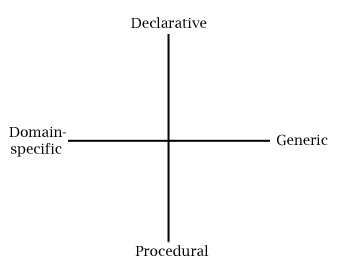
In this schema, domain-specific refers to knowledge of the data, concepts, and language particular to a distinct realm of knowledge such as physics or plumbing; while generic knowledge covers the general learning abilities which enable people to become successful independent learners – skills like self-confidence, self-discipline, organisation, communication and collaboration skills, critical thinking and reflexivity.
Declarative knowledge is explicit, conceptual, conscious and externalised knowledge of the kind that normally results from academic learning; as opposed to procedural knowledge which is implicit, instrumental, largely unconscious and internalised knowledge of the kind we associate with skillful practice of any kind.
While the declarative – procedural dimension is very similar to Lam’s explicit – tacit one, the domain-specific – generic axis draws attention to a different but equally important aspect of learning. In particular, many of the types of learning that are most important to a networked organisation in a fast-moving knowledge economy – generic learning skills which can only be developed through practice in a particular context – take place in the generic / procedural quadrant of the framework. This type of learning is cumulative and sustained, and yet more habitual than theoretical. And it is precisely this type of learning that the Just-in-time approach would seem least suited to delivering.
Mayes and de Freitas comment:
There is a growing agenda … giving greater emphasis to what are becoming called employability assets. These outcomes are all generic – not dependent on declarative knowledge – and include analytical and flexible learning capabilities, but also emphasise qualities that are much harder to specify as part of a curriculum: confidence, self-discipline, communication, ability to collaborate, reflexivity, questioning attitudes. These outcomes start to suggest a crucial role for the community of practice approach, and turn our attention to learning environments that provide maximum opportunity for communication and collaboration…
(Mayes & de Freitas, 2004)
….
Mayes, T & de Freitas, S, 2004, Review of e-learning theories,frameworks and models: JISC eLearning Models Desk Study, Stage 2, available online in pdf format from http://www.jisc.ac.uk/whatwedo/programmes/elearning_pedagogy/

The Just-in-time approach to learning clearly has huge advantages in delivering short bursts of bespoke, context-specific knowledge or skills to learners (especially workplace learners) wherever or whenever they are needed. But there are some learning settings – ones where learning needs to be more sustained, cumulative, theoretical or collaborative in nature – where Just-in-time seems less appropriate. So exactly what types of knowledge or cognition does Just-in-time work well for? To answer that question we need some tools for thinking about categories of knowledge.
Perhaps the best known knowledge typology is that of Alice Lam, which sees knowledge as extending in two dimensions: explicit-tacit (the epistemological dimension) and individual-collective (the ontological dimension). The interplay between these dimensions gives rise to four categories of knowledge, as follows:

(Lam, 2000)
Embrained knowledge, then, is formal, abstract and conceptual knowledge. It is general, conscious and explicit and is the result of individual acts of cognition. Embodied knowledge also resides primarily within individuals, but is applied, practical, bodily, context-specific and largely unconscious. Embodied knowledge is about doing rather than knowing.
Encoded knowledge is the collective, conscious knowledge of an organisation or society which has been codified into language or information – rules, standards and systems – which then regulate behaviour. Embedded knowledge is also collective, but instead of residing in an explicit code is tacitly embedded in social practice and a community’s shared beliefs and norms. Embedded knowledge is relation-specific, contextual and dispersed.
Lam’s typology makes it clear that much of an organisation’s most valuable knowledge exists at the tacit rather than the explicit level. But tacit knowledge, being neither fully conscious nor encoded, is something which is learnt through practice and over time and is not very readily engaged with via short bursts of targeted information. Just-in-time learning, then, would appear to be most useful for learning at the level of explicit knowledge, either embrained or encoded.
….
Lam A, 2000. Tacit Knowledge, Organizational Learning and Societal Institutions: An Integrated Framework. Organization Studies, Vol. 21 Issue 3, p487

In Diffusion of Innovations (core reading for H807 and a social science classic) Everett Rogers identifies compatibility as a key factor in the rate of spread of new technologies. Rogers means that to be successful, an innovation must not seem so alien to existing practice that people can’t imagine themselves using it. There needs to be a hint of continuity in among the newness.
Sometimes though, this need for compatibility has strange, backward-looking consequences which very nearly seem to cancel out the benefits of the innovation. Consider the fax machine, which became ubiquitous in offices in the 1980s and 90s. You start off with a digital document on a computer, but – instead of sending it directly down a telephone line – you make an analogue copy by printing it, then convert it back to digital by scanning it into the fax, send that down a telephone line, then at the other end convert it back again to an analogue form which is less useful than the digital document it started out as! The sole point of this wasteful round-about seems to have been to generate the familiar pieces of paper that office workers were used to.
From an ethnographic point of view, such behaviour looks almost like the cargo cults of Pacific islanders who fetishized the technologies of the first Europeans they encountered and made radios out of coconut shells and straw. Such misunderstood objects are described by sociologists as boundary objects: objects which mark the boundary between cultures, between conceptual worlds, only dimly understood because of their place at the periphery of what is known.
I’d argue that the CD-ROM, which as Martin Weller points out was once hyped as “the new papyrus” (Weller M, 2002), is another example of a boundary object, a digital instance of non-digital thinking. Think about it: you invest a lot of time and money making multimedia, interactive content which (if placed online) could be easily updated and distributed virtually free to anyone online; then you seal it into a piece of plastic so it can never be updated and becomes difficult and costly to distribute! Such crackpottery can surely only be explained in terms of an inability to escape from the model of the printed book which has been our main means of distributing knowledge these last 600 years.
That, plus a weird obsession with plastic.
Weller M, 2002. Delivering Learning on the Net. RoutledgeFalmer

The term “knowledge management” is one normally associated with the idea of the learning organisation – the kind of 21st century network enterprise that is equipped to take full advantage of the internet’s potential to make work a fulfilling learning experience for its workers. But according to Knowledge in Question: from Taylorism to Knowledge Management by Anne de Vos et al, knowledge management (KM) is in a direct line of descent from the soulless ‘scientific management’ prescriptions of the arch-theorist of early 20th century industrial mass production, Frederick Winslow Taylor.
The parallels are certainly striking. Taylorism and KM both attempt to solve the problem of transforming tacit, interiorised knowledge into explicit, collective knowledge, which is then available for the purpose of maximising efficiency across the organisation. Both approaches see the enterprise as a thing in itself, a repository of knowledge above and beyond the separate individuals who make it up. Both explicitly assume that enterprises are at least in principle zones free of social conflict, in which it is taken for granted that it’s in everyone’s interest for individual workers’ knowledge to be exteriorised, rendered explicit, codified and managed in the interests of market performance and profitability.
Both approaches reify the idea of knowledge, by seeing it as something that can be dissociated from individuals, analysed, formalised and stored. Finally, both approaches produce shifts in corporate power relationships as a result of the shifting patterns of knowledge ‘ownership’. Taylorism creates a new management layer of process experts, the codifiers and standardisers of shopfloor knowledge; while KM may give rise to another new group of experts in the form of information or knowledge managers, responsible for the efficient pooling and exchange of the organisation’s collective understanding. The paper concludes that
Despite the separation in time and the great disparity in the contexts in which each appeared, the work of Taylor and work done on KM both share a certain vision of the world.
Fascinating stuff…

It’s well known that new communications technologies diffuse in different ways and have different impacts on society compared with non-network innovations (because each new adoption makes them still more useful to existing adopters – see Everett Rogers’ Diffusion of Innovations for more on this). An article by Bobbie Johnson in today’s Technology Guardian got me thinking about another unique characteristic of network technologies: they are not labour-saving in the straightforward way that earlier technical innovations were.
“Take email, instant messaging and SMS,” writes Johnson.
It’s faster and easier than ever before, but it doesn’t reduce the workload because we simply spend more time doing it (Britons sent more than 50bn texts in 2007, for example – as many each week as they did in the whole of 1999). This reverses previous technological trends: just because the laundry process was now 10 times faster, we didn’t suddenly begin washing 10 times as many clothes. (The internet is the ultimate labour-creating device, Guardian Unlimited, 13/03/08)
Every time we need to find something out or exchange a thought, not only can we do so straightaway, but our attention will be caught by a dozen other things which we hadn’t until then been aware of needing to know or share. By giving us almost unlimited access to information and enabling us to communicate so easily, the net plugs into two of our most basic instincts as a species – to learn and to talk to each other – with the result that we spend more and more of our time doing these things.
This is why knowledge workers find themselves working harder and harder the more they embrace information technologies which originally promised to make their lives easier. As Johnson says,
It’s not for nothing that the net is characterised as a time sink, because wherever it carves out efficiencies, it usually manages to create extra work too.

Certainly it’s perceived to be a serious and growing one. One recent survey, by Northumbria Learning, found that half UK HE students believed their tutors would fail to spot work that had been plagiarised from the internet; while another, by the Times Higher Educational Supplement, found that 1 in 10 students had attempted to find model essays online. JISC, the UK HE technology advice and research body, has set up an Internet Plagiarism Advice Service and will be holding its third International Plagiarism Conference later this year. A JISC report suggested that student plagiarism was “common and probably becoming more so”; Oxford University has suggested that internet plagiarism was becoming so rife that the reputation of its degrees was in danger of being undermined; and Google has responded to these fears by banning adverts from the so-called ‘online essay mills’.
On the back of these concerns, plagiarism prevention has become highly profitable, with 90% of UK universities – more in north America – paying to use plagiarism-detection software, mostly using a package called Turnitin from US company Plagiarism.org, which uses a smart search of possible online sources combined with textual analysis of assignments using a rapidly growing database of past students’ work.
However there is little solid data supporting this perceived explosion of copying-and-pasting from the internet. Closer reading of the THES survey for example suggests that the overwhelming majority of student copying is done not online but offline from friends, and that only a tiny percentage of students – 3% – are copying wholesale chunks of text.
It’s not easy for academics to stand out against the plagiarism panic, but a few do. Barry Dahl, VP of Technology and Distance Learning at Lake Superior College, Minnesota, maintains there’s no evidence supporting the assertion that online plagiarism is more prevalent (it’s merely that online students get caught more than traditional students) and that plagiarism detection software is both a gross infringement of student intellectual property rights, and less effective than intelligent use of Google (see Turnitin Sucks).
And Steven Heppell, Professor of New Media Practice at Bournemouth University and UK government advisor on education and technology, thinks at least some of academia’s plagiarism concerns are the result of industrial-age thinking about learning as information transfer, students “learning stuff’ and then being tested to see how much of it has been absorbed. He points out in his weblog that
One huge impact of ubiquitous [internet] technology is to move information towards being a free good. So much information, so many providers. All the heated debates about IPR and plagiarism fall away with the realisation that, like Technology, Information is everywhere… (Play to Learn, Learn to Play, 20/10/2007)
In a learning environment where Google, Wikipedia and the social web have made virtually all information public, free, and collective in nature, the idea of information ownership begins to lose its meaning. Perhaps plagiarism too.

 JohnsBlog